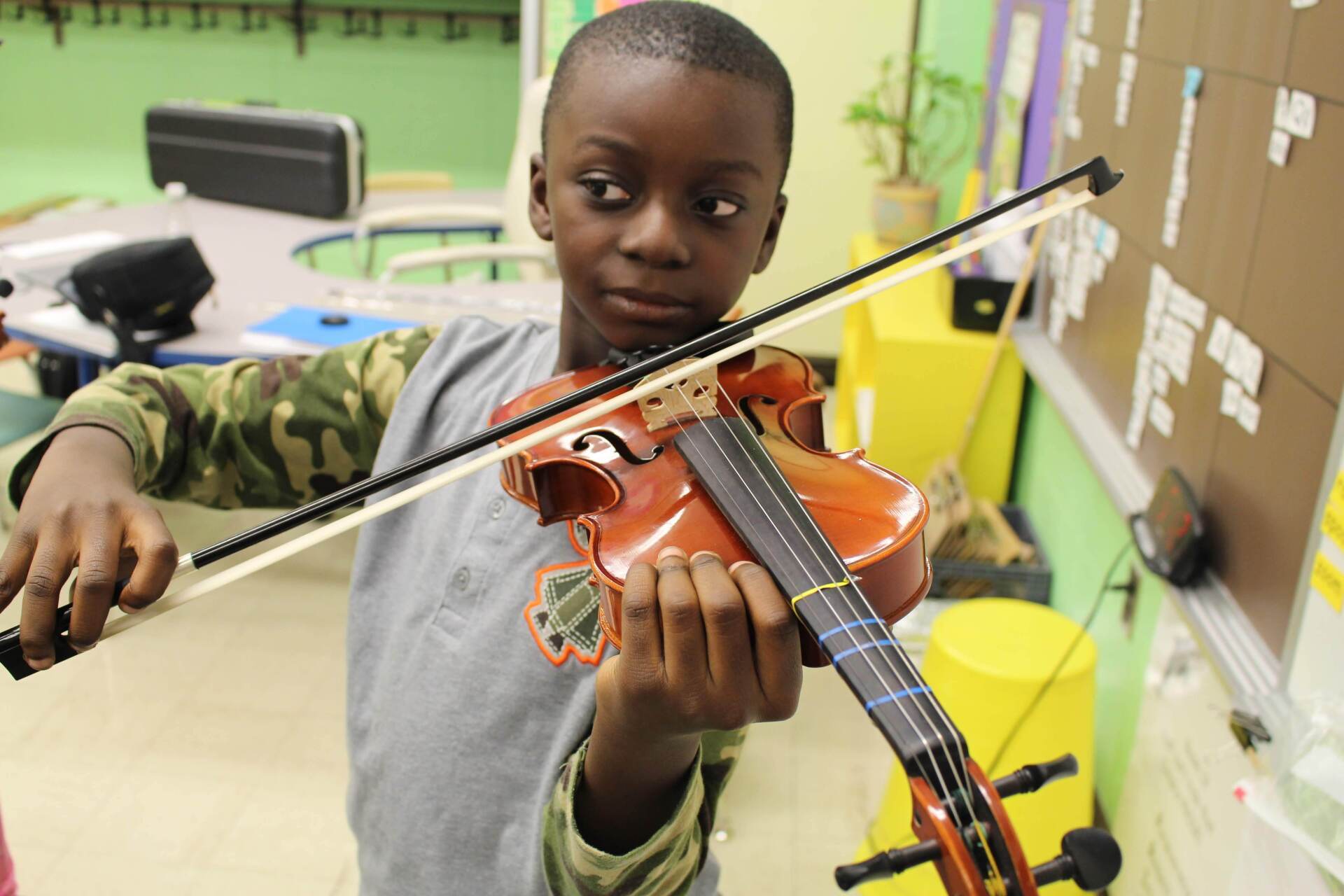
We recommend between 5-7 years old, slightly younger for the Suzuki method. Some instruments do not come in children's sizes and require considerable fine motor skills, so our teachers may recommend waiting until the child is in 4th or 5th grade. Attention span, reading skills and time for daily practice are other factors to consider. Early Childhood Classes are a great introduction to music.
Our Early Childhood classes are designed for newborns to children 5 years old. Parents are involved in all activities and classes are 30 to 45 minutes long. Class activities include singing and chanting, movement and pattern instruction. The goal of the curriculum is to increase children's music aptitude (potential to achieve in music) through engaging and entertaining musical activities, which will lay a foundation for lifelong music learning.
Our 6-week Instrument Sampler class for ages 6-9 gives children hands-on experience with various instruments. Discuss the various instruments with your child before enrolling him/her in private lessons. Selecting an instrument to study is an exciting and important decision.
In general we advise waiting until a child is 12 or 13 to begin private lessons. Training the voice is demanding on the vocal chords and putting too much stress on them before puberty may cause damage to them. Prior to that, singing in groups such as Rhode Island Children’s Chorus and church choirs are excellent methods to begin your child's vocal education.
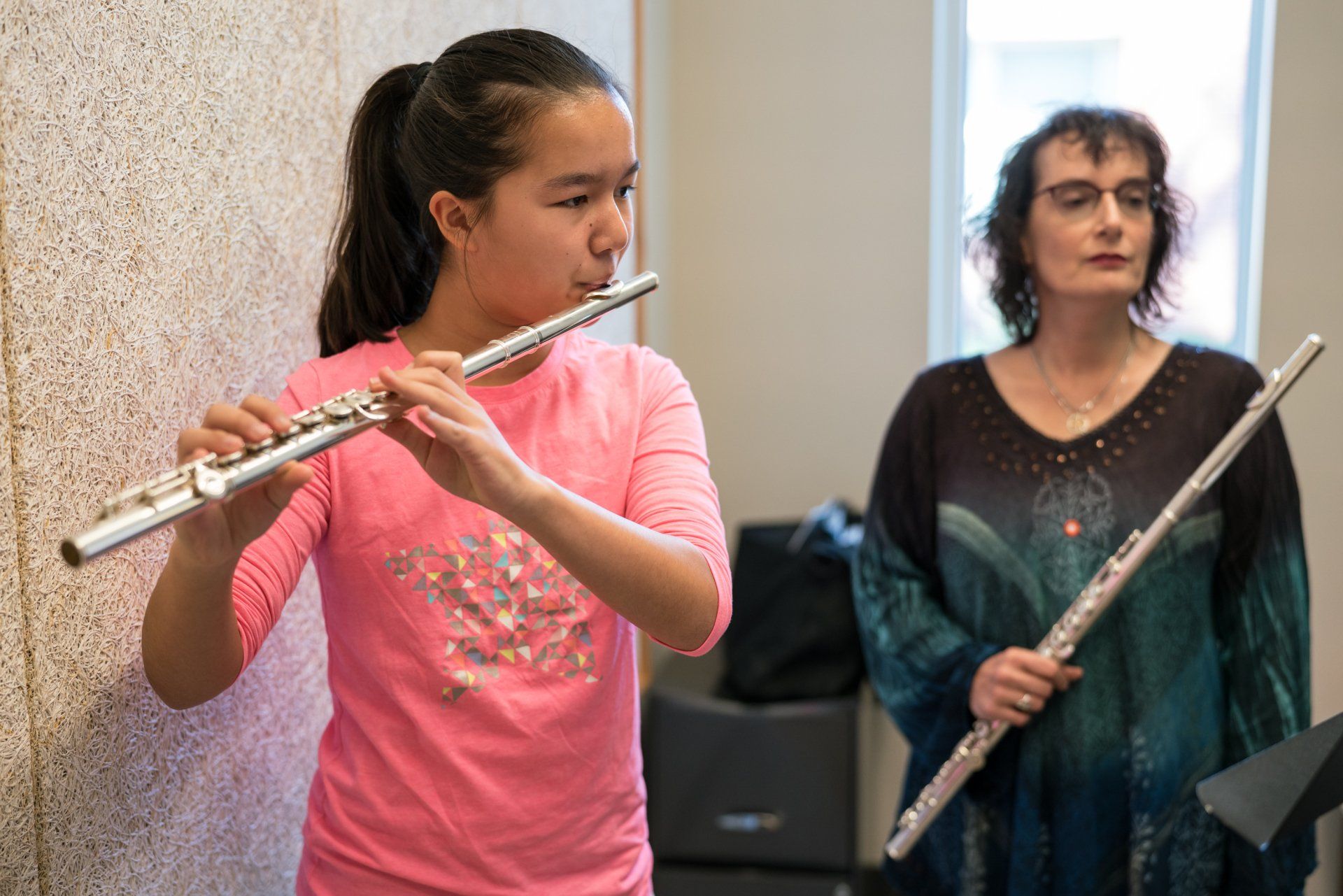
The Suzuki method is a way of teaching music to young children (ages 3-10) using the same principles used when learning language - listening, imitating and repeating. Dr. Shinichi Suzuki developed this method that focuses on ear-training, producing a beautiful tone and good instrumental technique. Parent responsibility, loving encouragement and constant repetition, are some of the unique features of the Suzuki approach. We have Suzuki-registered teachers for guitar, violin, piano, flute and cello.
Suzuki students learn music by rote; traditional method teaches students to read music from the beginning. The Suzuki method requires the parents to be strongly involved in the lessons, becoming a co-learner and daily home teacher. Both methods have weekly private lessons; Suzuki lessons are supplemented with regular weekly group classes. Our staff is happy to help you determine what method is best for your child.
Our teachers can teach what your child is most interested in. We place new students with a teacher based on their interest, level and availability. We encourage parents, students and teachers to discuss the music the student is learning and whether a different genre would be preferred.
You should have a piano for daily practice. Some keyboards are acceptable; please check with the teacher. The differences between keyboards and pianos make it undesirable to use a keyboard past the beginner level. Special care should also be taken when selecting a piano bench that is the appropriate height. Young piano students should also have a foot stool if their feet do not touch the floor.
No. Students come to one of our branches or occasionally to the teacher’s home for lessons. It helps create a sense of formality to lessons. Children can associate learning music with a special place and time.
Music students should practice only on the days they eat! Making a practice routine from the very beginning is important to the success of the student. Our teachers recommend a 6 year old practice 10-15 minutes a day. Older children should practice more. The length of practice time is not the only important factor - the quality of the practice is also important. Your child's teacher will provide how-to's and motivational techniques if your child is struggling.
Absolutely! It's never too late to take music lessons. We have adult students who never played any instrument before and others who resume lessons they had when they were younger. Adults learn quickly because they already know what the music is supposed to sound like and have the time and self-motivation to focus during daily practice sessions.
Children may become frustrated because they expected learning music would be easier. Parental support through this period is essential. If you're having problems helping with your child's progress at home, discuss it with the teacher. Our teachers will have advice or may be able to modify the lessons to help your child.
This depends on the child and the teacher’s preference. Some parents sit in on the lessons with young children while older children usually prefer to be alone. Discuss your preference with the teacher and see what works best for your child.
At the end of each semester, the Music School holds general recitals for any student ready to perform. Many teachers also have studio recitals with just their private students. We receive many invitations for student performances at retirement communities and Philharmonic events.
No, although we encourage all students to join. The focus needed to prepare for a performance is invaluable ,and recitals give a sense of accomplishment and boosts your child's self-esteem and ability to tackle challenges. If your child is nervous about recitals, we strongly recommend they attend in the audience.
We bill when students registered and we automatically place everyone on a quarterly payment plan.
We offer a two dollar per hour discount if we receive tuition payment in full before lessons begin in September. We offer a one-dollar per hour discount if we receive tuition payments semi-annually.
We operate on a two-term schedule: a school year session that runs from September to June and a summer session. We follow the calendar of the Providence public schools.
We will mail lesson confirmations before the beginning of the session in September for returning students and before the start of the first lessons for new students.
Our school year session is followed by two weeks of make-up lessons. Each private lesson student is allowed one excused absence between September-December and one excused absence from January-June. These lessons may be made-up either at a mutually convenient time for teacher and student or during the make-up weeks in June at the regular lesson day and time. If a student misses a scheduled make-up lesson, it is considered unexcused and will not be credited.
All students are expected to attend lessons every week unless their teachers have given them permission to register for fewer weeks. If the teacher agrees to fewer weeks, the student must complete a “Teacher Consent” form, have it signed by the teacher and submit it to the registrar, listing all the dates the student will be absent. Without a signed consent form, we will bill the student for all the weeks of the school year.
Our teachers will try to reschedule any lessons they cancel at a mutually convenient time or make them up at the end of the session in June. If teacher cancellations or school closings cannot be made up, the tuition will be credited to the student’s account.
If your family’s schedule changes between the date you register and the date you receive your day and time slot confirmation, please call us immediately, and we will make every effort to accommodate your change request before the session begins.
When you enroll for lessons, you are committing to a specific time slot. If your schedule changes, we will try to accommodate you. Because of our teachers’ schedules, we cannot guarantee a new time slot with the same teacher, but we may be able to find time with another.
Studying music is a long-term commitment and a disruption in the weekly routine of lessons and practice may affect your child’s progress. We will try to accommodate your new schedule, but we cannot guarantee that we will arrive at a mutually satisfactory solution.
Credit lessons represent payment for last 3 lessons of the school year session. Payment for credit lessons and the registration fee are due as a deposit at the time of registration and are non-refundable.